Groin Hernias
What is a Groin Hernia?
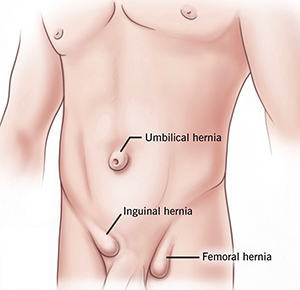
A groin hernia occurs when tissue from inside the abdomen pushes through a weakness in the muscles of the lower abdominal wall, creating a lump or bulge in the groin region.
Groin hernias are one of the most common surgical conditions. Although they are significantly more common in men, they do occur in women as well.
While some hernias cause little discomfort initially, they tend to enlarge over time and do not resolve without surgery.
Types of Groin Hernias
Inguinal Hernia
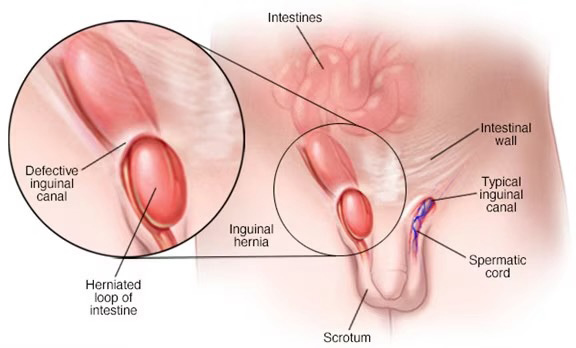
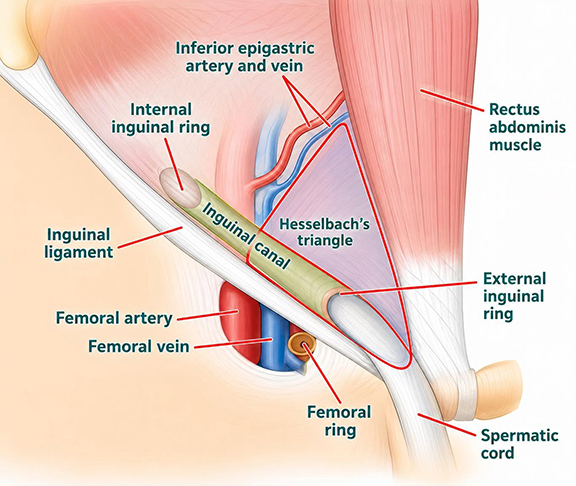
An inguinal hernia is the most common type of groin hernia. It occurs in the inguinal canal, a natural passageway through the lower abdominal wall through which the spermatic cord passes in men and the round ligament passes in women.
There are two types of inguinal hernia: direct and indirect. The distinction relates to the anatomical pathway taken by the hernia through the abdominal wall.
In practice, this distinction rarely affects treatment, as both are repaired using the same surgical techniques. However, indirect inguinal hernias are more likely to enlarge and may extend into the scrotum.
Although inguinal hernias most commonly occur on one side, they may be present on both sides simultaneously in up to 30% of patients.
Femoral Hernia
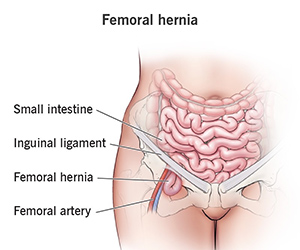
A femoral hernia occurs slightly lower in the groin where blood vessels pass into the leg. These hernias are less common but occur more frequently in women and carry a higher risk of incarceration and strangulation due to the tightness of the hernia opening.
Obturator Hernia
An obturator hernia is a rare type of pelvic hernia that occurs when abdominal contents protrude through the obturator canal, a small opening in the pelvic bone through which nerves and blood vessels pass. It most commonly affects elderly, thin women and often does not produce an obvious lump, making diagnosis challenging. Patients may present with bowel obstruction, abdominal pain, nausea and vomiting, or pain radiating down the inner thigh due to compression of the obturator nerve. Because obturator hernias carry a high risk of bowel strangulation, they usually require urgent surgical repair once diagnosed.
What Causes a Groin Hernia?
Groin hernias develop when a weakness in the lower abdominal wall combines with increased abdominal pressure to cause tissue to protrude through that weakness.
Factors that increase the likelihood of developing a hernia include:
- Increasing age
- Male gender
- Family history of hernias
- Heavy lifting, gym work or episodes of strenuous physical exertion
- Chronic coughing
- Chronic constipation and straining
- Obesity
- Pregnancy
- Smoking
What Are the Symptoms?
The most common symptom is a lump or swelling in the groin.
Other symptoms may include:
- Groin discomfort or aching
- A dragging or heavy sensation
- Pain during lifting, coughing or exercise
- Burning or sharp discomfort in the groin
- Swelling extending into the scrotum in men
Patients may notice that the lump fluctuates in size, often disappearing when lying down and becoming more obvious when standing, coughing or straining, particularly towards the end of the day.
Can a Groin Hernia Be Dangerous?
Most groin hernias are not immediately dangerous, particularly if they contain only fat. However, they do not heal spontaneously and generally enlarge over time, often becoming increasingly symptomatic.
Occasionally, a portion of intestine can become trapped within the hernia. This is known as incarceration and requires urgent medical attention.
If the blood supply to the trapped intestine becomes compromised, the hernia becomes strangulated. This is a surgical emergency.
Seek immediate medical attention if you develop:
- Severe or worsening pain
- A lump that becomes hard and cannot be pushed back in
- Nausea or vomiting
- Abdominal distension
- Redness or discolouration over the lump
What Happens If I Leave My Hernia Untreated?
Most groin hernias gradually enlarge over time. As they become larger, symptoms often worsen and surgery may become more technically challenging. There is also an ongoing risk that bowel or fatty tissue may become trapped within the hernia, potentially requiring emergency surgery.
For these reasons, surgical repair is generally recommended before complications develop.
How Is a Groin Hernia Diagnosed?
In most cases, diagnosis can be made during a clinical examination. You will be asked to point out the area of concern and then cough or strain, which often makes the hernia more prominent.
An ultrasound scan is frequently performed to confirm the diagnosis and identify the contents of the hernia. Occasionally, a CT scan may be required, particularly when symptoms are present but no obvious lump can be felt.
Do All Groin Hernias Need Surgery?
Because groin hernias do not heal spontaneously and usually enlarge over time, surgical repair is generally recommended. Early repair avoids the ongoing risk of incarceration and strangulation and allows surgery to be performed electively rather than as an emergency.
How Is a Groin Hernia Repaired?
Modern hernia surgery is most commonly performed using keyhole (laparoscopic) techniques, although robotic and open approaches may be appropriate in selected patients.
The optimal approach depends on the type of hernia, previous surgery and individual patient factors.
Click here to learn more about groin hernia surgery.
Why Choose A/Prof Craig Taylor?
A/Prof Craig Taylor is an experienced laparoscopic gastrointestinal surgeon with a particular interest in abdominal wall and hernia surgery.
He was the lead author of one of the world's largest randomised clinical trials investigating strategies to minimise pain following laparoscopic groin hernia repair and has performed more than 1,000 laparoscopic groin hernia repairs.
His practice focuses on modern evidence-based hernia surgery with an emphasis on safety, rapid recovery, low post-operative pain and durable long-term outcomes.
Consultations are available in clinic or via telehealth, with surgery performed at leading Sydney hospitals.
Arrange a Consultation
If you have a lump, discomfort or pain in the groin, an assessment can determine whether a hernia is present and whether treatment is recommended.
Early evaluation allows treatment to be planned electively before complications develop.